

NUH expands AI nursing notes after savings of up to 16 minutes

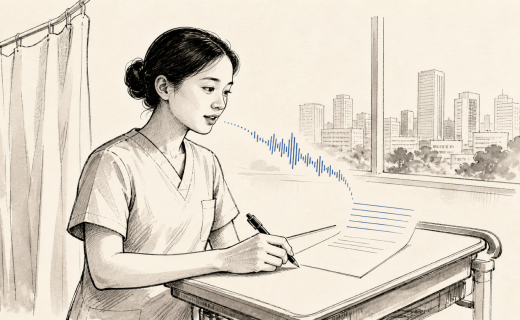
National University Hospital (NUH) is expanding the deployment of artificial intelligence speech-to-text tools into selected nursing workflows after pilot testing.
Early implementation data indicate documentation savings of up to 16 minutes per encounter in selected use cases. NUH is using two platforms to turn multilingual speech into structured notes: MediVoice, built in-house by National University Health System, and Scribe, developed by Singapore’s Open Government Products.
The tools serve different clinical and non-clinical needs while operating under risk controls. Staff use approved devices and platforms, review the output before use and work with nurse champions to refine workflows with developers. These controls matter because a fast draft has little value if staff must repair errors or if sensitive conversations move through unsuitable devices.
Performance metrics vary by clinical use case. A separate hospital report found that nurses using MediVoice generated clinical summaries 40 per cent more efficiently than with manual documentation. Advanced users saved about 10 minutes on a serious illness conversation or community meeting note. These measures differ from the reported 16-minute ceiling, but both point to the greatest operational value in documentation-heavy workflows.
Converting time savings into operational capacity
At the reported 16-minute ceiling, three qualifying encounters would release 48 minutes during a shift and five would release 80 minutes. This is potential capacity, not an immediate cash saving, because the time creates value only when managers can redirect it to patient care, discharge work or another constrained task.
Evaluating the strategic ROI requires comparing realised minutes with the full adoption cost, including product development or service support, device management, training and the time spent reviewing or correcting notes. A tool can reduce typing time yet fail to improve a shift if setup, consent or editing absorbs the gain.
To establish a realistic baseline for broader rollout, NUH should track median performance rather than peak pilot figures. It should also report department-level adoption and workflow compatibility, including the share of encounters suitable for transcription.
NUH should also measure the percentage of saved time that nurses can actually redirect to core operations. These figures would let managers estimate capacity by ward and shift without treating a selected-use-case result as a hospital-wide average.
Benchmarking in-house innovation against public infrastructure
The deployment strategy offers a useful comparison between an in-house product and shared public technology infrastructure. MediVoice gives the National University Health System control over clinical templates, hosting and product priorities, allowing a close fit with specialist workflows while concentrating maintenance, integration and support costs inside the health system.
Conversely, Scribe offers a shared public-sector model. Open Government Products says it built the service for public officers, that it supports most local languages, accents and dialects, and that it has safeguards for mobile use. Across all users, not NUH alone, Scribe logged 7,008 active users and 92,239 sessions in the second quarter of 2026, with an estimated 66.2 per cent saving in documentation time.
Running both systems gives NUH a practical build-versus-use comparison. MediVoice should win where clinical specificity and tighter system control justify internal costs, while Scribe should win where common templates, portable access and a shared government product lower deployment costs. A single product need not dominate every workflow.
Rigorous performance gates ahead of full-scale rollout
Before full-scale expansion, NUH needs accuracy results by language, dialect and mixed-language conversation. It should measure omissions, incorrect clinical terms and the editing time needed to produce a signed note. Consent rates and refusals should be tracked alongside privacy incidents, device access failures and staff use after training.
While human oversight should remain mandatory for quality assurance, the time required to verify transcripts represents an operational cost. NUH should compare documentation quality and patient safety with the previous workflow, then publish sustained results over several months. Wider deployment is justified only where net time savings remain positive after review, support and governance costs, without weaker records or patient trust.